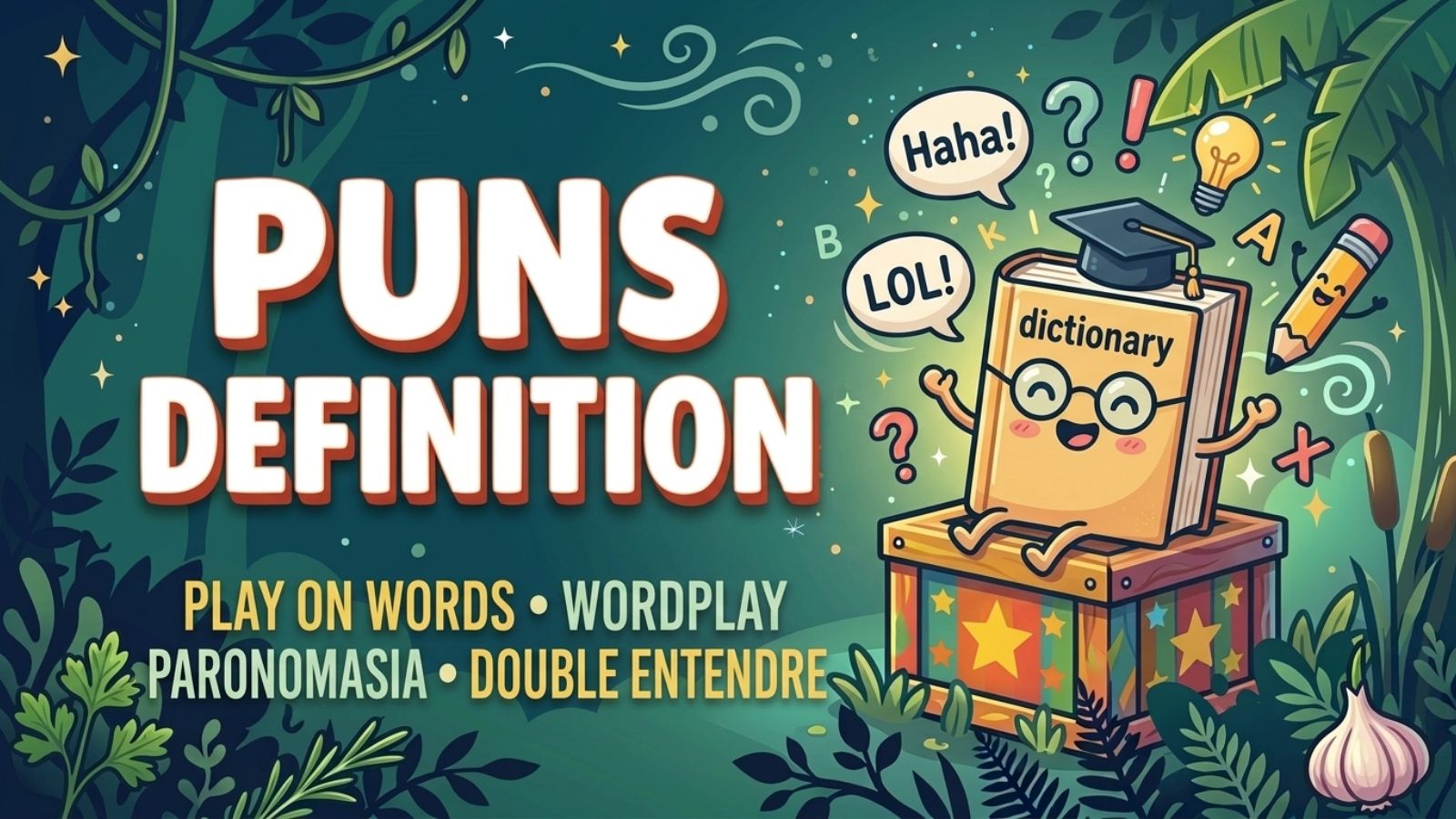
A pun is a form of wordplay that uses words with multiple meanings or similar sounds to create humor, cleverness, or a surprising twist. Puns appear in jokes, everyday conversations, books, advertisements, social media captions, and even movie titles. Some are easy to understand, while others make you think for a moment before the joke clicks.
Understanding the puns definition helps you recognize why certain jokes are funny and how writers use language creatively. From simple one-liners to clever double meanings, this guide explores what puns mean, the different types of puns, plenty of examples, and how you can create your own.
What Is the Definition of a Pun?
A pun is a joke or expression that plays on two or more meanings of a word or on words that sound alike but have different meanings. This technique creates humor by making the reader or listener interpret a word or phrase in an unexpected way.
For example:
– I used to be a banker, but I lost interest.
The word interest refers to both enthusiasm and money earned or paid on a financial account. The sentence works because both meanings fit the situation.
– The bicycle couldn’t stand on its own because it was two-tired.
Two-tired sounds like too tired, connecting the number of bicycle tires with the familiar expression for being exhausted.
– A boiled egg every morning is hard to beat.
The phrase hard to beat can mean difficult to defeat or difficult to surpass. The egg becomes the subject of a playful expression.
These examples demonstrate the central idea behind a pun: one word or phrase creates more than one possible interpretation. The humor comes from the connection between those meanings.
What Does “Pun” Mean in Simple English?
In simple English, a pun is a joke that uses words with double meanings or similar sounds to make something funny or clever.
For example, saying “I’m reading a book about anti-gravity. It’s impossible to put down” is a pun because put down can mean physically placing something down or stopping reading it.
Puns can be silly, intelligent, subtle, or deliberately cheesy. They are often short, making them easy to remember and share.
What Are the Main Types of Puns?
Puns come in several forms. Understanding these types makes it easier to identify wordplay and appreciate how a joke is constructed.
1. Homophonic Puns
Homophonic puns use words that sound alike but have different meanings, and sometimes different spellings.
Examples:
- The musician got locked out because he lost his keys. The joke can play on musical keys and keys used to unlock doors.
- The baker kneaded some time off. Kneaded sounds like needed, connecting baking with a common expression.
- The teacher said the math lesson was right on point. This can play on the idea of a point in mathematics and something being precisely correct.
The strongest homophonic puns rely on a clear connection between the sound-alike words and the situation.
2. Homographic Puns
Homographic puns use words that are spelled the same but have different meanings. Depending on the word, the pronunciations may also differ.
Examples:
- The fisherman was hooked on his new hobby. Hooked can refer to catching fish or becoming deeply interested in something.
- The gardener found the work growing on him. Growing can refer to plants developing or interest increasing.
- The comedian had a lot of material, but his delivery was flat. Flat can describe something lacking energy as well as something level.
These puns work by encouraging readers to recognize more than one meaning of the same written word.
3. Compound Puns
Compound puns combine multiple instances of wordplay in one expression. They may connect several meanings or related words to build a more elaborate joke.
Examples:
- The electrician had a bright idea, but the current situation was shocking.
- The gardener rose to the occasion and planted the seeds of success.
- The chef whisked through the recipe and stirred up some excitement.
Compound puns can be especially satisfying when the meanings fit together naturally rather than feeling forced.
4. Visual Puns
Visual puns communicate wordplay through images, illustrations, signs, or designs. They often combine a literal picture with a figurative expression.
For example, an illustration of a smiling clock wearing sunglasses could represent the phrase “having a good time.” A picture of a book sitting inside a refrigerator might play on the expression “a cool story.”
Visual puns are common in cartoons, posters, educational materials, greeting cards, and creative advertisements. They are particularly effective when the viewer can understand the joke at a glance.
5. Contextual Puns
Contextual puns depend on the surrounding situation to make the double meaning clear. A word might not seem funny by itself, but the setting gives it another interpretation.
Examples:
- The clockmaker’s business was winding down. The phrase can mean a business is slowing or ending, while winding also relates to traditional clocks.
- The gardener’s career was really taking root. The phrase suggests professional success while referring to plant roots.
- The photographer developed a new perspective. Developed connects photographic processing with personal or creative growth.
Contextual puns demonstrate how the same phrase can carry both a literal meaning and a figurative one.
Funny Pun Examples That Make Wordplay Click
Funny puns often take familiar expressions and give them an unexpected meaning. They are easy to share because the joke usually fits into a single sentence.
Here are some original-style pun examples for everyday laughs:
- I wanted to become a professional baker, but I couldn’t make enough dough.
- The calendar’s days were numbered from the beginning.
- The computer went to the doctor because it had a virus.
- The librarian was fully booked for the weekend.
- The musician couldn’t find the right note, so he took a break.
- The tailor had a close relationship with his work.
- The gardener was outstanding in his field.
- The coffee explained its feelings because it needed to espresso itself.
- The construction worker had a solid understanding of the job.
- The shoe factory had to put its best foot forward.
- The elevator company was taking its business to another level.
- The pencil felt pointless after someone sharpened the wrong end.
- The watchmaker knew the importance of spending time wisely.
- The chef kept his best ideas under wraps.
- The detective solved the case because he had a keen eye for detail.
The best funny puns do not need complicated explanations. They connect a familiar phrase to a new situation, allowing readers to discover the second meaning themselves.
Clever Puns and Double Meanings
Clever puns are less about silliness and more about finding an unexpected connection between words. They can make a sentence memorable without turning it into a full joke.
Consider these examples:
- The author had a novel approach to solving problems. Novel refers to both something new and a book-length work of fiction.
- The musician was in tune with his emotions. In tune relates to musical harmony and emotional understanding.
- The architect had a strong foundation for success. Foundation can describe a building’s base or the basis of an achievement.
- The astronomer needed space to think. Space refers to both room and the universe beyond Earth.
- The journalist had a pressing deadline. Pressing suggests urgency and connects with the printing press.
- The lawyer made a sound argument. Sound can mean logical and well-supported, as well as something heard.
- The artist drew a lot of attention. Drew refers to making a picture and attracting interest.
- The musician found the whole experience note-worthy. The phrase suggests something worth remembering while referring to musical notes.
Clever wordplay is particularly effective in writing because a single sentence can communicate an ordinary idea and an additional layer of meaning.
Cute and Simple Puns for Kids
Simple puns help children explore language while enjoying jokes. They can also be useful for classroom activities, creative writing, and conversations with friends.
Try these family-friendly examples:
- You’re one in a melon!
- Donut worry; be happy.
- I’m so fond of you, it’s un-bear-able.
- You’re paws-itively wonderful.
- Have an egg-cellent day!
- You make my heart soar.
- I be-leaf in you.
- You’re tea-riffic!
- Orange you glad we’re friends?
- I’m nuts about this idea.
- You’re dino-mite!
- Whale, hello there!
- You make life berry sweet.
- Let’s taco ’bout how awesome you are.
- You’re simply spec-taco-lar.
Some of these examples use sound substitutions rather than strict double meanings. That is part of the wider world of playful wordplay: a pun collection can include familiar expressions that twist a word’s sound, spelling, or meaning.
Punny Jokes: Short Setups and Punchlines
A pun can also form the punchline of a traditional joke. The setup creates an expectation, and the final phrase redirects the meaning.
Here are a few examples:
Why did the math book look worried?
Because it had too many problems.
Why did the gardener get promoted?
Because he was outstanding in his field.
Why did the musician bring a ladder to practice?
He wanted to reach the high notes.
Why did the bread refuse to argue?
It didn’t want to make a big crust.
Why did the photographer enjoy his new job?
He could see his future developing.
Why did the clock apply for a new position?
It wanted to make better use of its time.
Why did the chef get along with everyone?
He knew how to bring people together over a good dish.
Why did the electrician enjoy telling stories?
He always knew how to make a connection.
Pun-based jokes are often called dad jokes when they rely on deliberately obvious or cheesy wordplay. Their charm comes from the predictable setup and the surprisingly simple punchline.
Why Do People Use Puns?
Puns are more than a way to get a laugh. They are a practical form of wordplay that can make language engaging, memorable, and expressive.
Common reasons people use puns include:
- Humor: A double meaning can turn an ordinary sentence into a joke.
- Creativity: Puns encourage people to explore unusual relationships between words.
- Memorability: A clever phrase may stick in someone’s mind longer than a straightforward statement.
- Communication: A well-placed pun can make a conversation feel more relaxed and playful.
- Writing: Authors use puns to add personality, subtle humor, or extra meaning to a scene.
- Advertising: Businesses sometimes use wordplay in slogans and product names to make messages more noticeable.
- Learning: Puns can help readers notice homophones, multiple meanings, idioms, and other features of language.
However, not every pun works for every audience. A joke based on a particular pronunciation or cultural reference might be clear to one reader and confusing to another. The setting and the audience matter just as much as the wordplay itself.
How to Create Your Own Puns
Creating a pun becomes easier when you look for words with multiple meanings, similar sounds, or connections to familiar expressions. You do not need to be a professional writer to come up with clever wordplay.
Follow these simple steps.
1. Choose a Word With More Than One Meaning
Start with a word that has multiple definitions. Words such as light, note, date, current, and spring offer several possibilities.
For example, spring can refer to a season, a coiled object, or the act of jumping. Each meaning provides a different direction for a joke.
2. Look for Similar-Sounding Words
Think about words that sound alike but mean different things. Examples include flour and flower, right and write, or night and knight.
You can use one word in place of another to create a playful sentence, provided the context makes the intended connection clear.
3. Connect the Word to a Situation
A pun usually works best when its two meanings fit the context.
For example, if you are writing about a musician, consider words such as note, beat, pitch, and band. These words have meanings beyond music, making them useful starting points for jokes.
4. Keep the Wording Natural
Avoid forcing unrelated words together simply because they sound alike. A good pun should feel understandable, even if the reader needs a moment to recognize the joke.
Read the sentence aloud and consider whether someone unfamiliar with the idea could follow it.
5. Edit for Clarity and Timing
Remove unnecessary words and place the surprising phrase where it has the greatest effect. In a short joke, the final words often carry the punchline.
Remember that a pun does not have to make everyone laugh. Sometimes a clever connection is enough to make a sentence enjoyable.
Where Can You Use Puns?
Puns fit naturally into many kinds of everyday communication, especially when the goal is to make a message more playful.
- Social media captions: Use short wordplay to give a photo a memorable caption.
- Greeting cards: Add a pun to birthday cards, thank-you notes, or friendly messages.
- Classroom activities: Use puns to teach vocabulary, homophones, and multiple-meaning words.
- Creative writing: Include wordplay in dialogue, character names, or humorous scenes.
- Speeches and presentations: A relevant pun can provide a lighthearted opening or transition.
- Marketing and advertising: A concise pun can make a slogan easier to remember.
- Everyday conversations: Share a quick pun when the situation invites a little humor.
Choose wordplay that suits your audience. A simple pun may work well in a classroom, while a more subtle double meaning might suit a professional presentation. The goal is to make the message more engaging without distracting from its purpose.
Frequently Asked Questions About Puns
What is the simplest definition of a pun?
A pun is a form of wordplay that uses words with multiple meanings or similar sounds to create humor or a clever effect. For example, “I lost interest” can refer to losing enthusiasm or no longer earning interest on money.
What is an example of a pun?
“The bicycle couldn’t stand on its own because it was two-tired” is a classic example. The phrase two-tired sounds like too tired, combining the bicycle’s two tires with the idea of exhaustion.
What is the difference between a pun and a joke?
A joke is a humorous statement or story designed to entertain, while a pun is a specific type of wordplay based on meanings or sounds. A joke can contain a pun, but not every joke relies on wordplay.
What are the main types of puns?
Common classifications include homophonic puns, which use similar-sounding words, and homographic puns, which use words spelled the same but carrying different meanings. Compound, visual, and contextual puns are other useful categories, although classifications can overlap.
Why are puns funny?
Puns create a contrast between two possible meanings or interpretations. Readers initially understand a word one way, then recognize another meaning that changes the sentence. That unexpected connection can create humor, surprise, or appreciation for the writer’s creativity.
Are puns useful for learning English?
Yes. Puns can help English learners recognize homophones, multiple-meaning words, idioms, and figurative language. Some puns depend on cultural knowledge or subtle differences in pronunciation, so beginners may need a short explanation to understand them.
Give Wordplay a Try
The puns definition is simple: puns use multiple meanings, similar sounds, or clever word associations to create humor and surprise. Yet this small language technique can add personality to everything from everyday conversations to creative writing.
Whether you prefer cheesy one-liners, clever double meanings, or playful jokes for kids, the best puns make people look at familiar words differently. Start by choosing a word with an interesting second meaning, experiment with a few combinations, and see what works. You might come up with a joke that makes someone laugh—or at least earns a well-deserved groan!